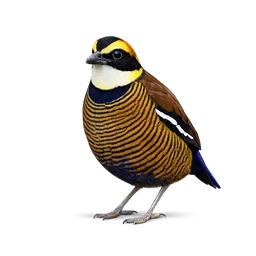
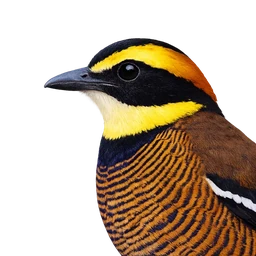
Profile
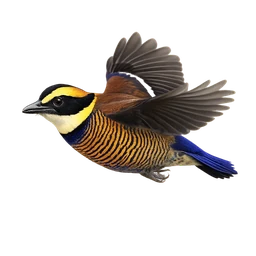
In flight
Pittas
Banded Pitta
Hydrornis guajanus
- rare
- 35 km/h
- Least Concern
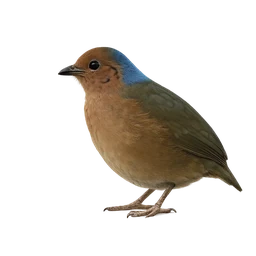
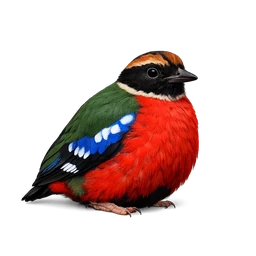
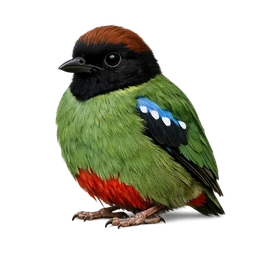
Haunts Java and Bali's rainforest floors in vivid bands of blue, orange, and black. Hunts earthworms with silent precision.
- Population
- Not numerically quantified in the IUCN assessment (no mature-individuals count published); suspected population reduction of 1-19% over the past 10 years based on ~3.2% tree-cover decline within its ~187,000 km² mapped range
- Habitat
- Lowland to submontane (up to ~1,500 m) subtropical/tropical moist broadleaf forest floor and dense understory with rich leaf litter, in both primary and degraded/secondary forest; a shy, ground-dwelling bird of the forest interior
- Fun fact
- What field guides long called the single species "Banded Pitta" was split in 2010 by ornithologists Rheindt and Eaton (Forktail 26) into three separate species — Javan, Malayan, and Bornean Banded Pitta — based on vocal, morphological, and behavioral differences.
- Range
- Endemic to Indonesia, restricted to the islands of Java and Bali; formerly treated as part of a wider "Banded Pitta" complex (Hydrornis guajanus sensu lato) that also included the Thai-Malay Peninsula/Sumatra population (now Malayan Banded Pitta, H. irena) and the Bornean population (now Bornean Banded Pitta, H. schwaneri) before a 2010 taxonomic split by Rheindt and Eaton
- Diet
- Primarily earthworms and snails picked from the leaf litter, supplemented with insects, centipedes, spiders, and occasionally small vertebrates such as frogs and skinks — typical of the Pittidae family
- Size
- 0.19 m
- Lifespan
- 8 years