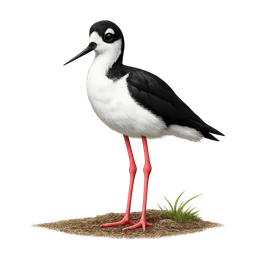
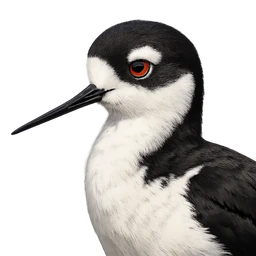
Profile
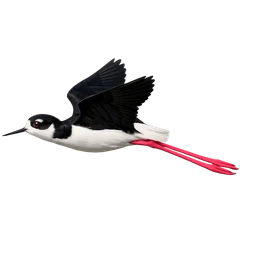
In flight
Cranes & Waders
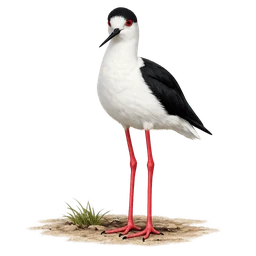
Black-necked Stilt
Himantopus mexicanus
- uncommon
- 40 km/h
- Least Concern
Looks like a shorebird drawn on chopstick legs. Pink stilts, opera-glove black wings, no apologies.
- Population
- ~900,000 (global breeding population estimate, Partners in Flight, confirmed via Cornell AllAboutBirds); Hawaiian subspecies (H. m. knudseni) is federally endangered with fewer than 2,000 individuals
- Habitat
- Shallow wetlands, favoring saline or brackish water: estuarine, lacustrine, salt-pond, and emergent-wetland habitats, including mudflats, salt marshes, salt evaporation ponds, lakeshores, and seasonally flooded fields; the Hawaiian subspecies uses freshwater wetlands
- Fun fact
- Each of the Black-necked Stilt's eyes is specialized for a different task — the left eye is used to watch for predators, competitors, and mates, while the right eye is used to locate and capture prey.
- Range
- Wetlands of the Americas, from the western and southern United States (including coastal California and the Hawaiian Islands) south through Mexico, Central America, and the Caribbean to Peru, Brazil, and the Galápagos Islands
- Diet
- Aquatic invertebrates — mainly crustaceans (e.g., shrimp, brine flies) and other arthropods (worms, insects) plus mollusks, small fish, tadpoles, and occasional plant seeds — gleaned by walking slowly through shallow water
- Size
- 0.37 m
- Wingspan
- 0.73 m
- Lifespan
- 12.4 years