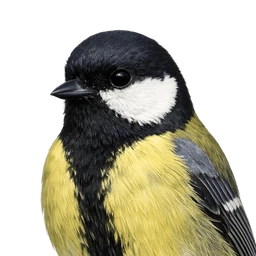
Profile
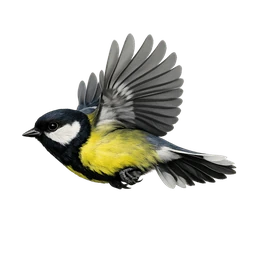
In flight
Songbirds
Great Tit
Parus major
- rare
- 55 km/h
- Least Concern
The bossiest songbird in the woodland. Has over forty distinct calls — every message is a different dialect.
- Population
- BirdLife International's 2018 global assessment (as reflected in BirdLife DataZone) estimates 423–683 million mature individuals, with a stable population trend; a wider secondary estimate sometimes cited (via Wikipedia) puts the range at 300 million–1.1 billion across a distribution of ~32.4 million km².
- Habitat
- Deciduous and mixed woodland, forest edges, hedgerows, farmland, parks and gardens; also boreal taiga in northern Siberia and oak forests in North Africa; highly adaptable to human-altered and urban environments.
- Fun fact
- Great tits have been recorded using a conifer needle held in the bill as a tool to winkle grubs out of holes in tree bark, and in a documented Hungarian cave population, great tits learned to kill and eat the brains of roosting hibernating pipistrelle bats during winter food shortages — the first recorded instance of a songbird systematically preying on bats.
- Range
- Widespread and largely resident across Europe, the Middle East, and Central Asia east to the Amur River basin, with populations also in parts of North Africa; range has been expanding northward into Scandinavia and Scotland.
- Diet
- Mainly insectivorous during the breeding season (caterpillars, spiders, other invertebrates fed heavily to nestlings); shifts to seeds, nuts and berries in winter and readily uses bird feeders/bird tables; notably opportunistic — some populations have learned to pierce milk-bottle foil caps, and in at least one Hungarian cave population, great tits have been documented systematically hunting and killing hibernating pipistrelle bats to eat their brains during winter food shortages.
- Size
- 0.135 m
- Wingspan
- 0.24 m
- Lifespan
- 14 years