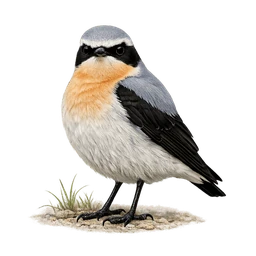
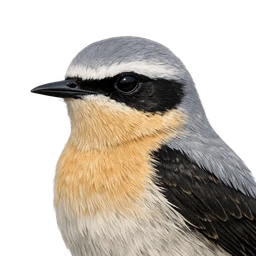
Profile
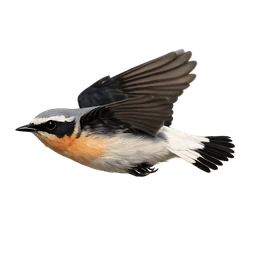
In flight
Songbirds
Northern Wheatear
Oenanthe oenanthe
- rare
- 55 km/h
- Least Concern
Tiny songbird that migrates from the Canadian Arctic to sub-Saharan Africa. Your message takes a 9,000-mile detour.
- Population
- Very large and widely banded by IUCN (10-500 million mature individuals globally); European breeding population alone estimated at ~5.3-15.8 million pairs (roughly 10.6-31.5 million individuals); overall population trend is decreasing
- Habitat
- Open, stony or sparsely vegetated terrain: tundra, upland moorland, sand dunes, shingle, cliff tops, heavily grazed heathland/downland, and pastures, from sea level up to ~2,800 m; avoids forested areas
- Fun fact
- Despite weighing only about 25-30 grams, Northern Wheatears breeding in Alaska and eastern Canada/Greenland undertake one of the longest migrations of any songbird, flying thousands of kilometers (in some cases nonstop across open ocean or ~14,500 km via Asia) to wintering grounds in sub-Saharan Africa.
- Range
- Breeds across the Northern Hemisphere from Alaska and eastern Canada/Greenland through Europe and the Palearctic to eastern Siberia/Mongolia; the entire global population migrates to winter in sub-Saharan Africa, including remarkable long-distance crossings (Alaskan birds fly ~14,500 km to Africa via Asia; eastern Canadian/Greenland birds cross the North Atlantic)
- Diet
- Primarily insects and other invertebrates (beetles, flies, ants, spiders), foraged on the ground, often from a low perch with a characteristic hop-and-peck technique; some berries taken in autumn
- Size
- 0.15 m
- Wingspan
- 0.29 m
- Lifespan
- 8 years