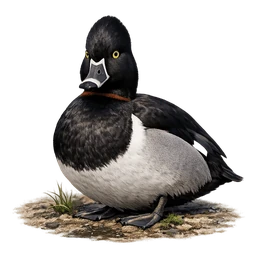
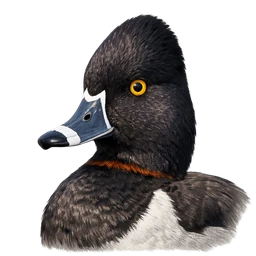
Profile
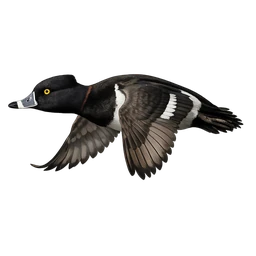
In flight
Waterfowl
Ring-necked Duck
Aythya collaris
- uncommon
- 72 km/h
- Least Concern
The ring is on the bill, not the neck. Whoever named this bird had never seen one in flight.
- Population
- ~2,000,000 mature individuals (2018 estimate), increasing
- Habitat
- Freshwater ponds, lakes, and marshes; nests over water in dense emergent marsh/bog vegetation in boreal and northern forest wetlands during breeding, and uses shallow freshwater lakes/ponds (occasionally brackish) in winter
- Fun fact
- Despite giving the species its name, the male's subtle chestnut-cinnamon neck ring is hard to see in the field, so birders more often identify the species by the bold white ring near the tip of its bill, earning it the nickname "ringbill."
- Range
- Breeds across the northern United States and Canada (boreal forest belt); winters across the southern and coastal United States, Mexico, and Central America (to Costa Rica/Panama); rare vagrant to Western Europe (including Britain/Ireland) and northern South America
- Diet
- Omnivorous diving duck; ducklings and breeding females eat mostly aquatic invertebrates (midges, dragonfly/caddisfly larvae, mollusks, leeches, earthworms), while adults otherwise feed heavily on aquatic vegetation and seeds (pondweed, water lilies, wild celery, wild rice, sedges, arrowhead)
- Size
- 0.42 m
- Wingspan
- 0.625 m
- Lifespan
- 20 years