
Profile
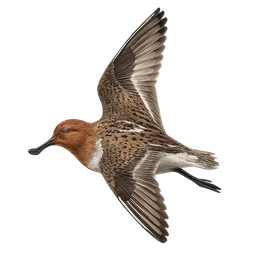
In flight
Seabirds
Spoon-billed Sandpiper
Calidris pygmaea
- legendary
- 8 km/h
- Critically Endangered
Fewer than 500 adults remain, about 443 at last count. Spoon-shaped bill scoops messages from the tiniest crevices.
- Population
- Critically Endangered with population continuing to decline. Two recent authoritative estimates differ slightly in framing: BirdLife/IUCN's 2021 assessment gives 240-620 mature individuals (best estimate ~490), declining ~8%/year; a more recent Birds of the World (Cornell Lab) update cites a 2024 estimate of a mean global population of ~443 mature individuals (range 331-554), declining ~5%/year. Both agree the species numbers in the low hundreds and is falling — treat exact figure as a moving target, with ~440-490 mature individuals as the best current central estimate.
- Habitat
- Breeds on coastal tundra and adjacent hinterland (sea coasts, sand/shingle spits near freshwater pools) on Russia's Chukotka Peninsula; on migration and in winter it uses coastal mudflats, estuaries, salt pans, and lagoons
- Fun fact
- The Spoon-billed Sandpiper is the only wader in the world with a spatula-shaped bill tip, which it sweeps side-to-side through shallow mud and water to feel out and snap up tiny invertebrates.
- Range
- Breeds in a very restricted range on the Chukotka Peninsula, northeastern Siberia (Russia); migrates along the East Asian-Australasian Flyway through Japan, the Koreas, and China to winter on coastal South and Southeast Asia, with records from India, Bangladesh, Myanmar, Thailand, Vietnam, southern China, Sri Lanka, the Philippines, Peninsular Malaysia, and Singapore
- Diet
- On the tundra breeding grounds, eats insects (midges, flies, beetles), spiders, and some plant matter (e.g., moss); on migration and wintering mudflats it feeds mainly on small marine invertebrates such as shrimp, amphipods, worms, and other crustaceans, using its uniquely spatulate bill to sift through soft mud
- Size
- 0.15 m
- Wingspan
- 0.35 m
- Lifespan
- 16 years