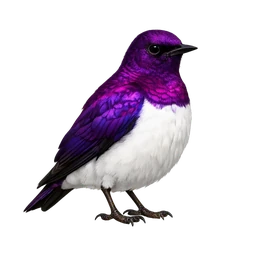

Profile
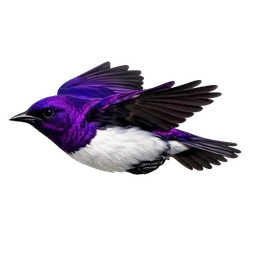
In flight
Songbirds
Violet-backed Starling
Cinnyricinclus leucogaster
- epic
- 48 km/h
- Least Concern
The male's back is pure structural violet, no pigment at all. Angle changes, color explodes.
- Population
- Not quantified in any accessible source; described qualitatively as common and widespread across its sub-Saharan African range (BirdLife DataZone/IUCN factsheet numeric data inaccessible — JS-rendered placeholder even via reader proxy).
- Habitat
- Open woodland, gallery forest, forest edges and clearings; avoids dense Congo Basin rainforest and the arid parts of southwestern Africa; recorded up to ~2,100 m elevation.
- Fun fact
- Male Violet-backed Starlings are among the most iridescent birds in Africa, with a glossy amethyst-violet head and back that contrasts sharply with pure white underparts, while females look entirely different — a cryptic, thrush-like brown and streaked plumage — making the sexes easy to mistake for two different species.
- Range
- Widespread across sub-Saharan Africa in three subspecies: C. l. leucogaster from Senegal/Gambia through the Sahel to South Sudan, Ethiopia, Kenya and Tanzania; C. l. verreauxi from southern DR Congo through Tanzania south to Botswana, northeastern South Africa and Mozambique; C. l. arabicus from eastern Sudan to northwest Somalia and into the southwestern Arabian Peninsula (Saudi Arabia, Yemen).
- Diet
- Mainly fruit and seeds supplemented with arthropods; forages chiefly in the forest canopy (rarely on the ground) and sometimes hawks flying insects flycatcher-style.
- Size
- 0.18 m
- Wingspan
- 0.29 m
- Lifespan
- 10 years