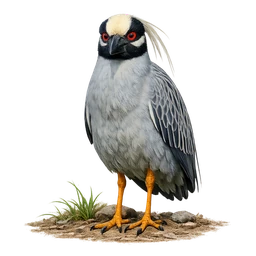
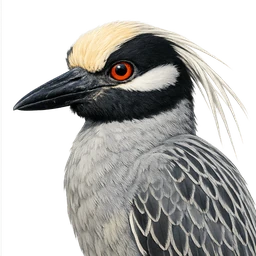
Profile
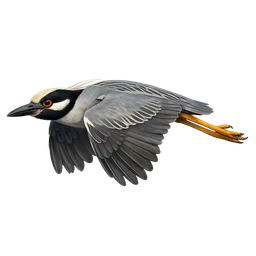
In flight
Cranes & Waders
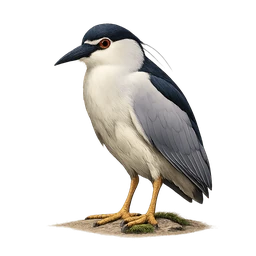
Yellow-crowned Night-Heron
Nyctanassa violacea
- uncommon
- 40 km/h
- Least Concern
Specializes in crab and crayfish, cracked open with a stout bill. Delivers messages on the late shift.
- Population
- Not numerically quantified in sources reviewed — BirdLife DataZone lists "Number of mature individuals" as unknown/poor-quality (derived from a 2009 estimate) and describes the global population as very large with an overall stable trend, though North American surveys show a small/statistically insignificant decline over the last 40 years
- Habitat
- Marshes, wooded swamps, and lakeshores inland; thickets, mangroves, and rocky/cliff-bound coasts, coastal marshes, and barrier islands near the coast; also uses wet lawns, golf courses, and wooded river valleys
- Fun fact
- Despite its name, the Yellow-crowned Night-Heron often hunts by day as well as at night (coastal birds forage on tidal rhythm rather than a light/dark cycle), and specializes so heavily on crustaceans that crabs and crayfish, which it catches with a quick lunge and either shakes apart or swallows whole, form the bulk of its diet.
- Range
- The Americas: breeds along the southeastern and eastern coasts of the United States (year-round resident on the southern Atlantic/Gulf coasts, breeding as far north as the Midwest and southern Great Lakes/Ontario/Michigan in summer), through Mexico, Central America, the Caribbean, and northern/coastal South America to Peru and Brazil; also found in the Galápagos Islands and (introduced, late 1970s, for land-crab control) Bermuda
- Diet
- Primarily crustaceans — especially crabs and crayfish, caught with a lunge and either shaken apart or swallowed whole — supplemented with insects, fish (including eels and pipefish), worms, amphibians, molluscs, lizards, snakes, small rodents, and small birds; forages by day and night, with coastal populations timing activity to tides rather than daylight
- Size
- 0.63 m
- Wingspan
- 1.07 m
- Lifespan
- 6.3 years