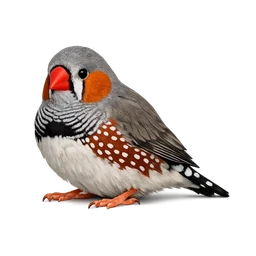
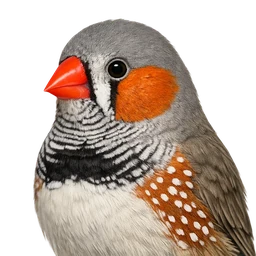
Profile
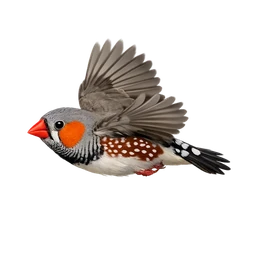
In flight
Songbirds
Zebra Finch
Taeniopygia castanotis
- common
- 40 km/h
- Starter
- Least Concern
The most-studied songbird on Earth. Scientists use it to decode how brains learn language. Your message, decoded.
- Population
- Abundant and widespread across mainland Australia; no precise global population count published by IUCN/BirdLife, but assessed with a stable population trend
- Habitat
- Arid and semi-arid savanna, grasslands, scrubland, and open or grassy woodland with scattered shrubs/trees, typically near water or areas of concentrated rainfall; readily adapts to agricultural land and urban/suburban areas
- Fun fact
- The zebra finch is one of the most widely used model organisms in neuroscience because young males learn their courtship song from a tutor during a critical developmental period, making it a key model for studying vocal learning and speech-related brain circuitry.
- Range
- Native to roughly 75% of mainland Australia (absent from the cool humid south and the wet tropical far north, e.g. Cape York Peninsula); small introduced/escaped populations established elsewhere from the pet trade (e.g. Puerto Rico, Portugal)
- Diet
- Primarily grass and other seeds, dehusked with its short conical bill; supplements with insects and other invertebrates (especially important for breeding females and chicks), plus some flowers/green vegetation
- Size
- 0.105 m
- Lifespan
- 5 years