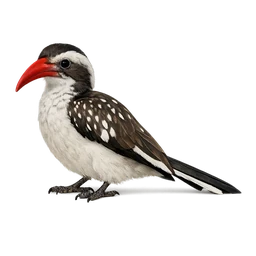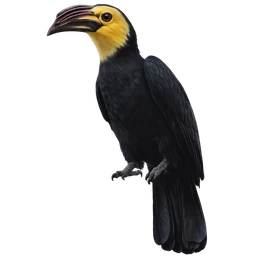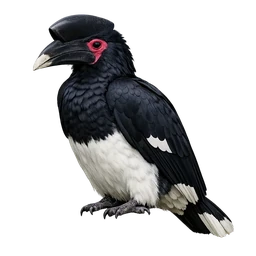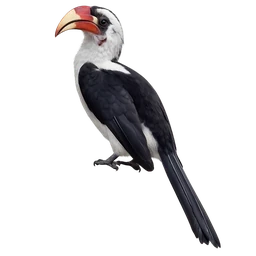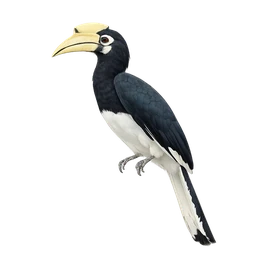
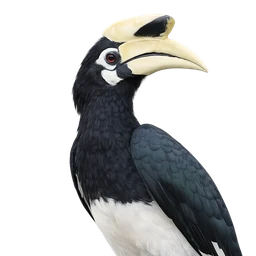
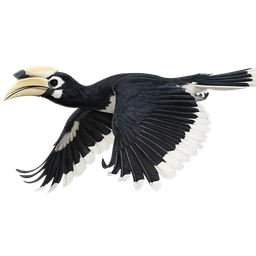
Rangkong (Hornbills)
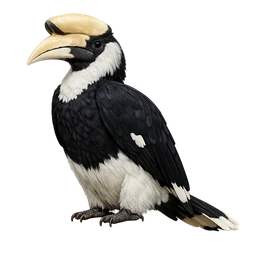
Oriental Pied Hornbill
Anthracoceros albirostris
- tidak umum
- 43 km/h
- Risiko rendah
The female seals herself inside a tree cavity for months. The male feeds her through a slit. Delivery, redefined.
- Populasi
- Not numerically quantified; species is described as common, widespread, and "the most common of the Asian hornbills," with a stable-to-increasing trend in parts of its range (e.g., Singapore's reintroduced/recovered population)
- Habitat
- Subtropical/tropical moist lowland forest, including dry and semi-evergreen forest, deciduous forest, secondary forest, forest edge, riverine woodland, plantations, and other cultivated areas near forest — considered the hornbill species most adaptable to habitat alteration
- Fakta menarik
- The Oriental Pied Hornbill went locally extinct in Singapore by the 1960s but recolonized and recovered there in the 1990s, becoming a conservation success story and an important seed disperser for the region's forests.
- Sebaran
- South and Southeast Asia: two subspecies — nominate A. a. albirostris from northern India and southern Nepal (also Bangladesh, Bhutan, Myanmar) east to southern China (Yunnan, SW Guangxi) and south to northern Peninsular Malaysia, southwestern Cambodia, Laos, Thailand, and southern Vietnam; A. a. convexus in Peninsular Malaysia, Sumatra, Borneo, Java, Bali, and smaller islands. Also present in Singapore, where it was extirpated by the 1960s and has since recolonized/recovered.
- Makanan
- Omnivorous; predominantly frugivorous (figs, berries, rambutans, palm fruit, and other wild fruits) supplemented with insects, small reptiles and amphibians, fish, small mammals, small birds, and birds' eggs/nestlings
- Ukuran
- 0,58 m
- Masa hidup
- 15 tahun