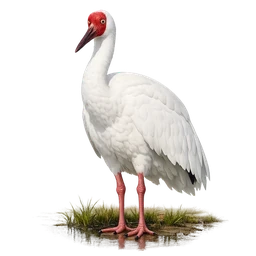
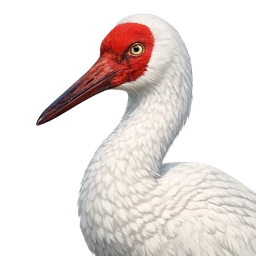
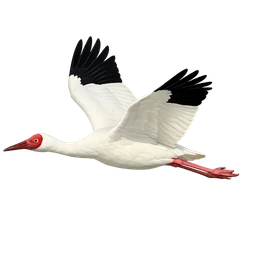
Jenjang dan burung perancah (Cranes & Waders)
Siberian Crane
Leucogeranus leucogeranus
- selestial
- 90 km/h
- Kritis
Almost all that remains of the species winters on one Chinese lake. A long white line crossing a continent that may not survive the loss of a single wetland.
- Populasi
- Approximately 3,500-4,000 individuals globally, over 99% in the Eastern Flyway population wintering at Poyang Lake, China; the Western/Central population is functionally down to a single wild bird. A higher figure of "greater than 5,500" has also been reported.
- Habitat
- Breeds on moss-covered marshland in Arctic taiga-tundra; winters on wide, shallow (up to ~30 cm) freshwater wetlands, lake shallows, mudflats, and flooded rice fields with good visibility, avoiding areas of frequent human activity
- Fakta menarik
- The Siberian Crane's western migratory population has collapsed to essentially a single wild bird, nicknamed "Omid" (Persian for "hope"), which for years wintered alone on Iran's Caspian coast without a mate.
- Sebaran
- Breeds in Arctic Russia in two disjunct areas (Yakutia in the east; western Siberia near the Ob River, now nearly extirpated). The large Eastern population migrates through Russia, Mongolia, and northeastern China to winter at Poyang Lake, Jiangxi Province, China. The remnant Western/Central population historically wintered at Fereydoon Kenar on Iran's Caspian coast; a further historical central-flyway contingent wintered in India (Keoladeo/Bharatpur) but is now considered extinct there. Vagrants recorded in Japan, South Korea, and Hong Kong.
- Makanan
- Largely vegetarian: roots, tubers, seeds, and aquatic vegetation (e.g., Vallisneria spiralis), cranberries and other berries; also opportunistically takes small mammals (lemmings, voles), fish, insects, and earthworms
- Ukuran
- 1,2 m
- Bentang sayap
- 2,35 m
- Masa hidup
- 15,7 tahun