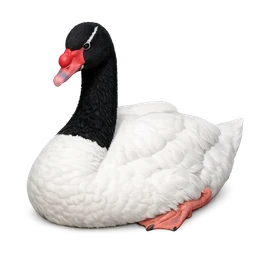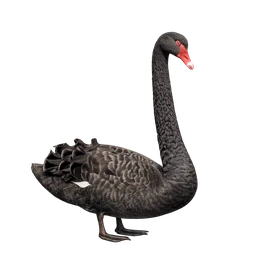
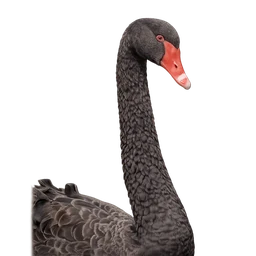
Profile
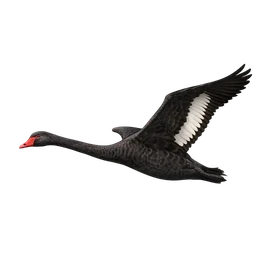
In flight
Waterfowl
Black Swan
Cygnus atratus
- epic
- 80 km/h
- Least Concern
Found naturally only in Australia, proving the philosophers wrong. Entirely black except white flight feathers.
- Population
- c. 100,000–1,000,000 individuals (global, IUCN 2018 assessment); population trend stable
- Habitat
- Large freshwater, brackish, and salt-water wetlands — permanent and seasonal lakes, swamps, rivers, and coastal/estuarine lagoons with underwater and emergent vegetation; also ornamental lakes
- Fun fact
- About one-quarter of black swan pairings are male-male couples; these pairs obtain eggs by stealing nests or forming temporary threesomes with a female (driving her off once she has laid), then co-parent the cygnets — confirmed via Wikipedia's cited behavioral literature.
- Range
- IUCN lists native (breeding) range as Australia and New Zealand (extent of occurrence ~9.96 million km²); non-native/naturalized populations established in Europe (notably the UK), Japan, Spain, parts of the US (Florida, California), and mainland China. Note: NZ status is nuanced — Black Swans were deliberately introduced from Melbourne in the 1860s, but authoritative NZ ornithological sources (NZ Birds Online) and IUCN classify the resulting population as "native," reasoning that natural colonisation likely coincided with/followed the introductions.
- Diet
- Almost entirely herbivorous: submerged and floating aquatic vegetation, algae, and marshland plants, obtained by plunging its long neck underwater (up to ~1 m deep); occasionally grazes land plants
- Size
- 1.3 m
- Wingspan
- 1.8 m
- Lifespan
- 40 years