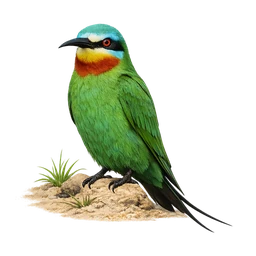
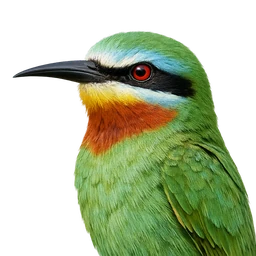
Profile
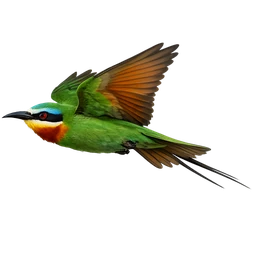
In flight
Tropical Birds
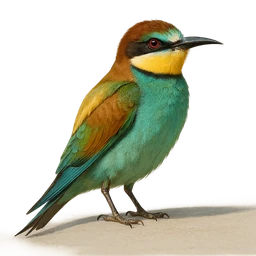
Blue-cheeked Bee-eater
Merops persicus
- epic
- 72 km/h
- Least Concern
Eats stinging insects and rubs the venom out of them on a perch first. Brings your message and a packed lunch.
- Population
- 150,000–400,000 mature individuals, increasing (BirdLife DataZone / IUCN Red List assessment; population figure sourced to a 2018 estimate cited within the current live assessment)
- Habitat
- Breeds in subtropical semi-desert, steppe, dunes, saline pans, cultivation, thorn woodland, and sandy river/lake banks with sparse trees (e.g. acacia); winters in savanna, broad river valleys, open woodland, grassland, lakeshores, and swamps.
- Fun fact
- Before eating a bee or wasp, a Blue-cheeked Bee-eater beats and rubs the insect against its perch to discharge the venom and remove the sting, a behavior shared across the Meropidae family.
- Range
- Breeds from eastern Turkey/North Africa and the Middle East through Central Asia (Kazakhstan) to northwest India; a long-distance migrant wintering mainly in tropical sub-Saharan Africa, with some Sahel populations resident year-round. Breeding/resident extent of occurrence ~31.1 million km2; non-breeding extent ~24.7 million km2 (BirdLife DataZone).
- Diet
- Almost exclusively aerial insects caught on the wing — bees, wasps, and hornets (venom discharged by beating/rubbing the insect against a perch), plus large numbers of dragonflies and damselflies; hunts from open perches such as telephone wires.
- Size
- 0.31 m
- Wingspan
- 0.475 m
- Lifespan
- 8.1 years