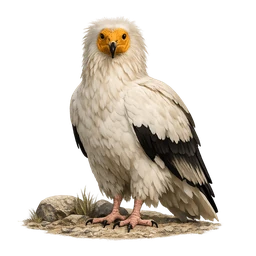
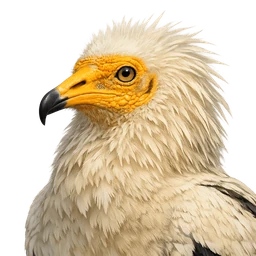
Profile
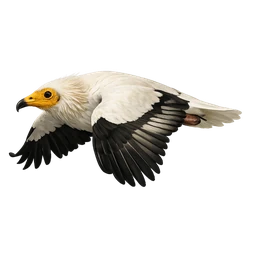
In flight
Vultures & Condors
Egyptian Vulture
Neophron percnopterus
- uncommon
- 40 km/h
- Endangered
One of the few birds that uses tools — drops stones to crack ostrich eggs. Your message is in clever hands.
- Population
- 12,400–36,000 mature individuals, decreasing
- Habitat
- Open, arid and semi-arid lowland and montane country — dry plains, deserts, grasslands, savanna, and rocky cliffs/canyons used for nesting; also human-occupied areas near villages/towns for foraging; generally avoids forest; ranges up to ~2,000 m elevation (Himalayan foothills) in summer.
- Fun fact
- The Egyptian Vulture is one of the few birds known to use tools — it picks up and throws stones with its bill to crack open thick-shelled ostrich eggs, and separately uses twigs to gather wool for nest lining.
- Range
- Fragmented range across southern Europe, North Africa, the Middle East, and Central/South Asia into India, with isolated populations in southern Africa (e.g. Namibia); resident populations in the Canary Islands, Cabo Verde, and Socotra; northern breeders are migratory and winter in the Sahel and elsewhere in sub-Saharan Africa.
- Diet
- Opportunistic, indiscriminate scavenger feeding mainly on carrion and refuse/garbage, supplemented with small mammals, reptiles, insects (incl. in dung), and bird eggs; the only Old World vulture that regularly consumes feces (source of carotenoids for facial coloration); one of the few bird species known to use tools, cracking large eggs such as ostrich eggs by throwing/tossing stones at them with its bill.
- Size
- 0.6 m
- Wingspan
- 1.6 m
- Lifespan
- 21 years