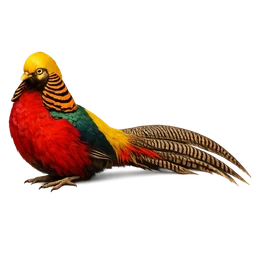
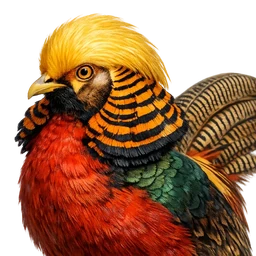
Profile
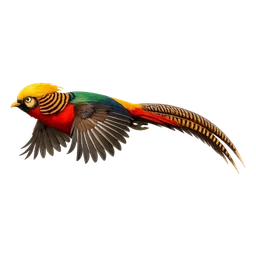
In flight
Game Birds
Golden Pheasant
Chrysolophus pictus
- legendary
- 38 km/h
- Least Concern
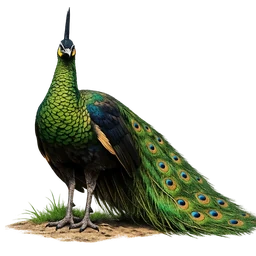
Native to Chinese mountain forests. The male's cape fans open like a halo when displaying. Pure flex.
- Population
- Global population not numerically quantified by IUCN/BirdLife DataZone; qualitatively described as fairly common within its native Chinese range, with a decreasing (but not rapid) population trend. A separate introduced UK population, historically estimated at roughly 1,000-2,000 individuals, is now confirmed via BTO BirdFacts to have collapsed further — only ~15 males recorded in the 2010-14 national survey, with the species "too rarely reported... to properly assess" current numbers and considered likely to go extinct in the UK wild soon.
- Habitat
- Dense mountain forests and woodland with thick shrub and bamboo undergrowth, including dark coniferous/mixed broadleaf forest at roughly 1,000-3,000 m elevation; in winter descends to forest edges near cultivation/human settlements to forage.
- Fun fact
- Despite their dazzling golden-and-scarlet plumage, Golden Pheasants have weak chest musculature and are poor fliers, preferring to run from danger and only flushing into short, clumsy bursts of flapping flight as a last resort.
- Range
- Native to mountainous forests of central and western China (Sichuan, Shaanxi, Gansu and surrounding provinces); breeding endemic, non-migratory, extent of occurrence ~1,010,000 km² per BirdLife DataZone. Small introduced/feral populations established historically in the United Kingdom (now very scarce/near-extirpated, centered on Breckland, Norfolk) and reported in scattered locations elsewhere (continental Europe, New Zealand, Hawaii, and other locations per Wikipedia) from aviary escapes.
- Diet
- Omnivorous ground forager: grain, seeds, leaves, berries, tender shoots of shrubs/bamboo, rhododendron flowers, and occasional invertebrates (ants, beetles, grasshoppers, spiders, earthworms); winter diet shifts heavily toward wheat leaves and seeds.
- Size
- 1 m
- Wingspan
- 0.7 m
- Lifespan
- 6 years