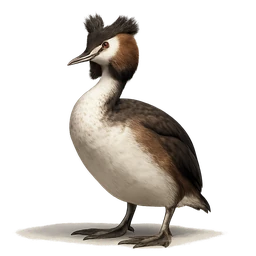
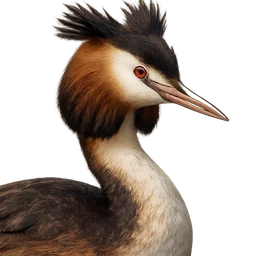
Profile
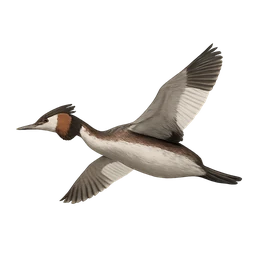
In flight
Seabirds
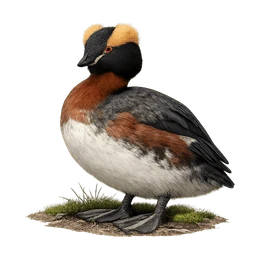
Great Crested Grebe
Podiceps cristatus
- uncommon
- 35 km/h
- Least Concern
Famous for its romantic dances. Delivers love letters with extra passion.
- Population
- roughly 915,000-1,400,000 individuals globally (BirdLife/Wetlands International also cites ~610,000-997,000 mature individuals)
- Habitat
- Freshwater lakes, reservoirs, and slow rivers with emergent and submerged vegetation for breeding (typically 0.5-5m deep); winters on large ice-free lakes, reservoirs, and sheltered coastal waters less than 10m deep
- Fun fact
- Great Crested Grebes perform an elaborate mutual courtship "weed dance," rising breast-to-breast on the water while shaking bundles of waterweed in their bills, a display first scientifically documented by Julian Huxley in his landmark 1914 paper "The Courtship-habits of the Great Crested Grebe," a founding work of avian ethology.
- Range
- Widespread across Europe, central and southern Asia to Japan, with scattered breeding populations in Africa (from Tunisia and Egypt to South Africa) and established breeding populations in Australia and New Zealand; northern populations migrate south to winter in milder regions including southern Asia and northern India
- Diet
- Primarily fish, supplemented with aquatic insects, small crustaceans, molluscs, small frogs and newts, and occasionally aquatic plants
- Size
- 0.48 m
- Wingspan
- 0.66 m
- Lifespan
- 12 years