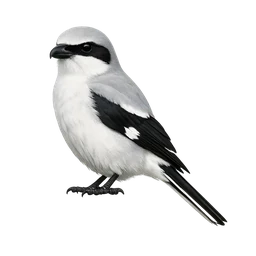
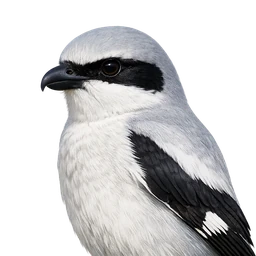
Profile
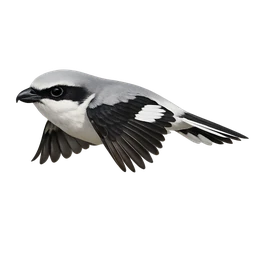
In flight
Songbirds
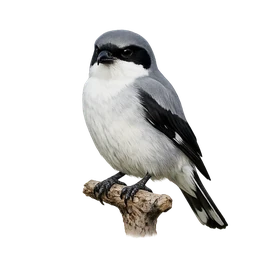
Great Grey Shrike
Lanius excubitor
- uncommon
- 45 km/h
- Least Concern
Impales prey on thorns to eat later, the 'butcher bird.' Europe's largest shrike, grey with a black mask.
- Population
- Global population estimated at 640,000–1,250,000 mature individuals (BirdLife/IUCN, 2018 assessment basis), with a decreasing overall trend; regionally, Sweden holds a stronghold of roughly 20,000–50,000 birds while many other European national populations number only in the hundreds to low thousands
- Habitat
- Open country with scattered elevated perches — grassland, heath, and shrubland edges with hunting lookouts (fence posts, wires, isolated trees); requires roughly 5-15 perch sites per hectare; avoids dense unbroken forest
- Fun fact
- The Great Grey Shrike's scientific name, Lanius excubitor, literally means "butcher watchman" — fitting for a songbird nicknamed the "butcher bird" for impaling captured prey on thorns or barbed wire, creating a larder it returns to feed from later, and even skinning toxic toads to avoid their poison.
- Range
- Breeds across northern Eurasia (and marginally northern Africa) roughly north of 50°N, from Scandinavia and central/eastern Europe east through Russia; northern/eastern populations are short-distance migrants wintering further south in temperate Europe and parts of Asia, while some temperate European populations are largely resident
- Diet
- Carnivorous predator of small vertebrates and large invertebrates — voles, lemmings, and other small rodents make up over half the diet by biomass, supplemented by shrews, small songbirds, lizards, frogs, beetles, and grasshoppers; known for impaling prey on thorns or barbed wire to create a larder it returns to feed from, and for skinning toxic toads to avoid their poisonous secretions
- Size
- 0.24 m
- Wingspan
- 0.33 m
- Lifespan
- 12 years