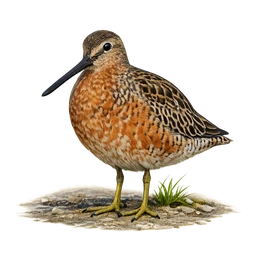
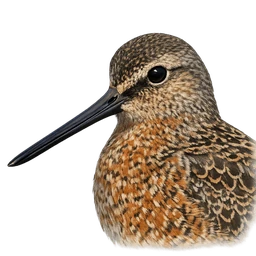
Profile
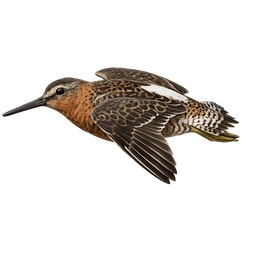
In flight
Cranes & Waders
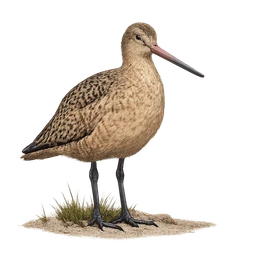
Long-billed Dowitcher
Limnodromus scolopaceus
- common
- 28 km/h
- Starter
- Near Threatened
Identical to its cousin except for the bill, the call, and the habitat. Birders argue about it for sport.
- Population
- ~500,000–1,000,000 mature individuals (BirdLife/Partners in Flight midpoint ~800,000; 2025 State of the Birds report cites ~650,000 breeding individuals), decreasing
- Habitat
- Breeds on wet Arctic/subarctic sedge and grass freshwater meadows near tundra ponds; on migration and in winter uses mudflats, flooded fields, wet meadows, shallow lakes and estuaries, favoring fresh water and muddy substrates (typically <3 inches deep) over sandy or saline ones
- Fun fact
- The Long-billed Dowitcher feeds with a distinctive rapid up-and-down "sewing-machine" bill motion, probing deep into soft mud to find prey by touch — and can even forage nocturnally during migration.
- Range
- Breeds in western/northern Alaska, northwestern Canada, and eastern Siberia (easternmost Russia, Wrangel Island, east to Chukotka); winters across the southern United States and Mexico, concentrated along the Pacific coast (British Columbia to Baja California), the Gulf Coast/Mississippi Valley, the Atlantic coast (North Carolina to Florida), and California's Central Valley, with smaller numbers reaching Central America and limited numbers into South America
- Diet
- Probes soft mud and shallow water with its long bill in a rapid "sewing-machine" motion, locating prey partly by touch; eats chironomid (midge) larvae, other insect larvae, beetles and caterpillars on the breeding grounds, and a mix of polychaete worms, amphipod crustaceans, mollusks and some plant seeds during migration and winter
- Size
- 0.29 m
- Wingspan
- 0.48 m
- Lifespan
- 9 years