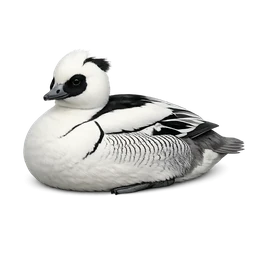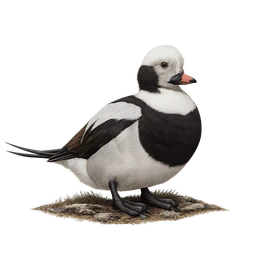
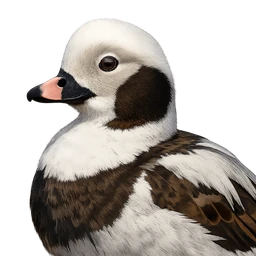
Profile
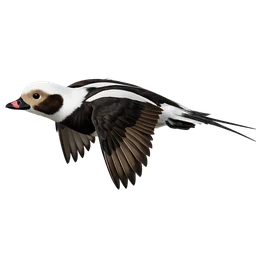
In flight
Waterfowl
Long-tailed Duck
Clangula hyemalis
- uncommon
- 72 km/h
- Vulnerable
Most vocal duck in the Arctic, yodeling 'ow-owdle-ow' across the ice. Dives over 200 feet for prey.
- Population
- Global population estimated roughly 6.2–6.8 million mature individuals (BirdLife-derived figure via Animal Diversity Web), but declining — most notably the Baltic Sea wintering concentration, once the world's largest at ~4.5 million, which has fallen >60% since the 1990s; no single fully current (post-2018) global total could be directly confirmed via BirdLife DataZone or IUCN Red List (both inaccessible to automated fetch)
- Habitat
- Breeds on Arctic and subarctic tundra pools, marshes, and mountain/tundra lakes; winters at sea on oceans and large lakes (e.g. Baltic Sea, Great Lakes, Hudson Bay)
- Fun fact
- The Long-tailed Duck is one of the deepest-diving ducks in the world, capable of descending to around 60 m (200 ft) and using its partly opened wings for underwater propulsion as it forages on the seafloor.
- Range
- Circumpolar Holarctic distribution — breeds across northern North America (Alaska, Arctic Canada), Greenland, Iceland, Scandinavia, and the Siberian Arctic (including Kamchatka); winters along Atlantic and Pacific coasts, the Baltic and other northern seas, and the Great Lakes
- Diet
- Mollusks, crustaceans, small fish, and aquatic insects/invertebrates, obtained by diving (among the deepest-diving ducks, reaching roughly 60 m/200 ft)
- Size
- 0.53 m
- Wingspan
- 0.71 m
- Lifespan
- 22 years