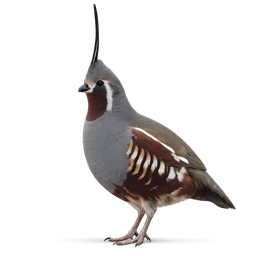
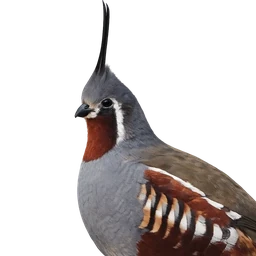
Profile
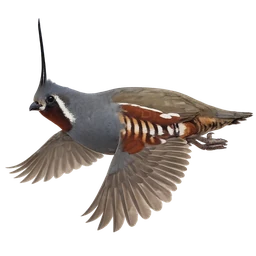
In flight
Game Birds
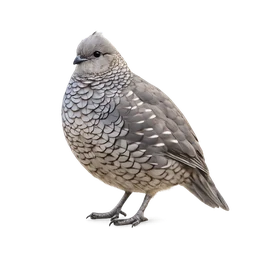
Mountain Quail
Oreortyx pictus
- epic
- 44 km/h
- Least Concern
North America's largest quail. Migrates by walking downhill in winter, then walking back up in spring. No shortcuts.
- Population
- ~260,000 mature individuals (Partners in Flight estimate, corroborated via Cornell Lab All About Birds); population trend is DECLINING, not stable — the IUCN assessment lists the global trend as Decreasing, and PIF survey data show roughly a 4.3%/year decline from 2005-2015 in significant parts of the range (Idaho, Nevada, eastern Oregon/Washington), driven by habitat loss to grazing, agriculture, drought, and development.
- Habitat
- Dense, remote mountainous chaparral and shrubby slopes; an elevational migrant that breeds in montane woodland/brush up to ~3,000 m (10,000 ft) and moves down to lower ridges, foothills, or desert-edge scrub in autumn/winter.
- Fun fact
- The largest quail species in the United States, Mountain Quail cope with heavy mountain snowfall not by flying south but by walking — whole family coveys descend on foot from high breeding elevations (up to ~3,000 m / 10,000 ft) to lower wintering grounds each autumn, an elevational migration performed almost entirely on foot rather than by sustained flight.
- Range
- Western North America, from southwestern British Columbia (Canada, including an introduced Vancouver Island/coastal population) south through Washington, Oregon, California, and Nevada to the Baja California peninsula, Mexico.
- Diet
- Primarily seeds, bulbs, acorns, berries, and other plant matter; chicks feed heavily on insects (especially beetles and ants in summer) before shifting to the largely plant-based adult diet.
- Size
- 0.27 m
- Wingspan
- 0.38 m
- Lifespan
- 5 years