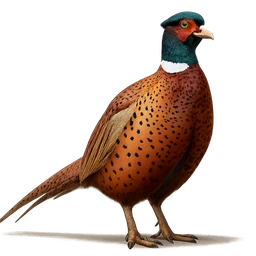
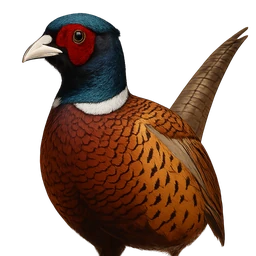
Profile
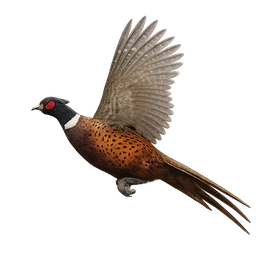
In flight
Game Birds
Ring-necked Pheasant
Phasianus colchicus
- uncommon
- 56 km/h
- Least Concern
Explodes from the brush with a startling whirr. Dramatic entrances guaranteed.
- Population
- No single precise global figure corroborated by a primary source; species is very large, stable-to-increasing globally, abundant in native Asian range and enormous in introduced/naturalized populations across Europe (tens of millions released annually in the UK alone for hunting), North America, New Zealand, and elsewhere
- Habitat
- Farmland, grassland, woodland edges, scrub, and wetland margins; favors open agricultural fields, weedy roadsides, and hedgerows, plus grassland near water with small tree/copse cover; highly adaptable, also found in some forest, desert-edge, and varied-elevation settings
- Fun fact
- The male Ring-necked Pheasant's iridescent copper-and-gold plumage, red facial wattles, and white neck ring make it one of the most visually striking introduced game birds in North America, where it has been established since the 1880s.
- Range
- Native to Asia and extreme southeastern Europe, from the eastern Black Sea and Caspian Sea across to Manchuria, Siberia, Korea, mainland China, and Taiwan; widely introduced and naturalized in Europe, North America (United States and southern Canada, since the 1880s), Japan, New Zealand, and elsewhere
- Diet
- Omnivorous — seeds, grain, mast, fruit, berries, and leaves, plus invertebrates such as earthworms, slugs, grasshoppers, beetles, caterpillars, and ant eggs/wireworms; diet shifts toward animal prey and greenery in spring/summer and toward seeds/grain in colder months; occasionally small vertebrates like lizards or voles
- Size
- 0.7 m
- Wingspan
- 0.71 m
- Lifespan
- 3 years