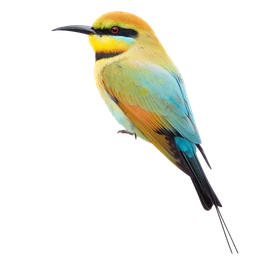
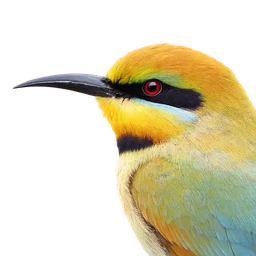
Profile
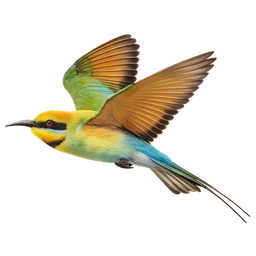
In flight
Bee-eaters & Rollers
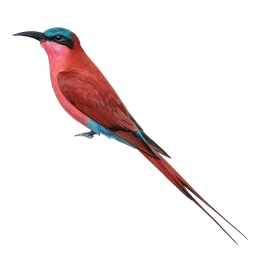
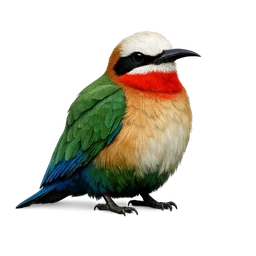
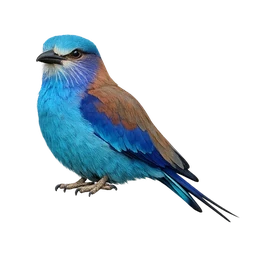
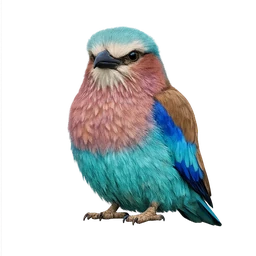
Rainbow Bee-eater
Merops ornatus
- rare
- 50 km/h
- Least Concern
Australia's only bee-eater. Catches bees mid-air, rubs off the venom on a branch, then eats them anyway.
- Population
- BirdLife International/IUCN estimate at least 1,000,000 individuals total, with a documented figure of ~670,000 mature individuals (2009 estimate); population trend suspected stable. Regionally, reporting rates on Australia's East Coast have dropped over 50% since 2001, but this has not shifted the global assessment.
- Habitat
- Open forests, woodlands, shrublands, cleared farmland/orchards/vineyards, sand dunes, cliffs, mangroves, disturbed sites (quarries, mines), and parks/gardens, typically near water and with sandy banks/ground for nesting burrows.
- Fun fact
- Rainbow bee-eaters are unfazed by their prey's weapons: after catching a bee or wasp mid-air, they beat and rub it against a perch to rupture and discharge the venom sac, closing their eyes to avoid being squirted before swallowing it.
- Range
- Breeds across mainland Australia (all states/territories except Tasmania) in the austral summer; migrates north for the non-breeding season to northern Australia, New Guinea, eastern Indonesia, Timor-Leste, and occasionally the Solomon Islands, with vagrants recorded in Japan, Taiwan, and Palau. Extent of occurrence roughly 15.9–17.2 million km² per BirdLife DataZone.
- Diet
- Flying insects caught on the wing (aerial sallying), overwhelmingly bees and wasps (several hundred a day), plus dragonflies, beetles, butterflies, and moths; stingers are beaten/rubbed off against a perch before the insect is swallowed.
- Size
- 0.24 m
- Lifespan
- 7 years