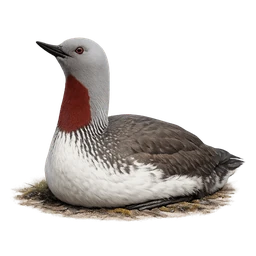
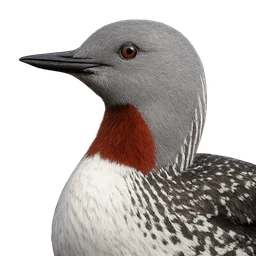
Profile
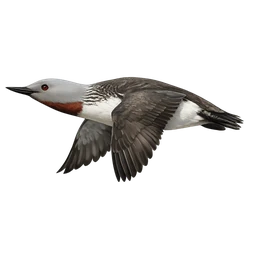
In flight
Seabirds
Red-throated Loon
Gavia stellata
- rare
- 84 km/h
- Least Concern
Smallest and most agile loon, can take off from a puddle. Most loons need a runway; this one doesn't.
- Population
- 200,000-600,000 mature individuals globally (European breeding population ~42,100-93,000 pairs); population trend decreasing overall, though North American populations have been stable over the past 40 years and some populations are stable/unknown-trend
- Habitat
- Breeds on small freshwater tundra/taiga pools and lakes in open moorland, bogs, and peatlands (lowland to ~3,500 ft elevation), often using pools as small as 10-20 m long, then flying to larger lakes or the sea to feed; winters in shallow coastal marine waters, sheltered bays, and estuaries near land rather than far offshore, occasionally on inland lakes/rivers.
- Fun fact
- The Red-throated Loon is the smallest and lightest of the world's loon species and, unlike other loons that need a long pattering run across open water, it is the only one able to take flight directly from land or a small pond; in the air it flies swiftly, able to stall, pivot, and drop with almost falcon-like precision.
- Range
- Circumpolar Arctic breeder, generally north of 50°N across North America, Europe, and northern Eurasia/eastern Asia; winters along Pacific and Atlantic coasts of North America (south to Florida and California), western Europe to Portugal/Mediterranean/Black Sea, and Pacific coasts of Asia south to southeast China and Japan.
- Diet
- Primarily small fish (e.g., herring, capelin, sculpin, sandlance, cod, stickleback, arctic char), supplemented with crustaceans, mollusks, squid, leeches, polychaete worms, frogs, aquatic insects, and occasionally fish spawn or plant material, caught by pursuit-diving.
- Size
- 0.6 m
- Wingspan
- 1.05 m
- Lifespan
- 23.6 years