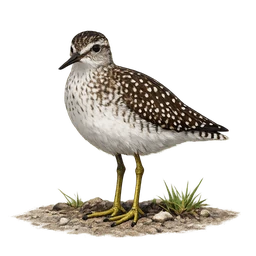
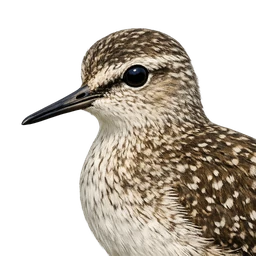
Profile
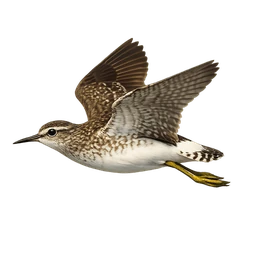
In flight
Cranes & Waders
Wood Sandpiper
Tringa glareola
- uncommon
- 40 km/h
- Least Concern
The most elegant of the small shore-waders. Migrates from Arctic bogs to African wetlands with your message in tow.
- Population
- ~3.02–4.62 million mature individuals globally (BirdLife International/IUCN, 2021 estimate)
- Habitat
- Breeds in open, swampy boreal/subarctic habitat — mossy marshes, wet heathland and scrubby forest bogs (willow, dwarf birch or spruce) between tundra and coniferous forest. On migration and in winter it favors inland freshwater wetlands: lake and pond margins, muddy marshes, flooded grassland, reservoirs and even sewage farms, rarely true coastal habitat.
- Fun fact
- Before its long migratory flights a Wood Sandpiper can build up fat reserves equal to roughly half its body mass, fueling nonstop journeys of up to about 4,490 km between breeding and wintering grounds.
- Range
- Breeds across the northern Palearctic from Scotland and Scandinavia through northern Europe and Siberia to the Russian Far East. A long-distance migrant wintering mainly in sub-Saharan Africa and across South and Southeast Asia to southern China, the Philippines, Indonesia, New Guinea and Australia, with vagrants recorded in North America, Hawaii and Micronesia.
- Diet
- Probes shallow water and wet mud for aquatic and terrestrial invertebrates — beetles, true bugs, fly larvae, worms, spiders, small crustaceans and molluscs — and will also take small fish up to about 2 cm, tadpoles and occasionally frogs.
- Size
- 0.2 m
- Wingspan
- 0.37 m
- Lifespan
- 8 years