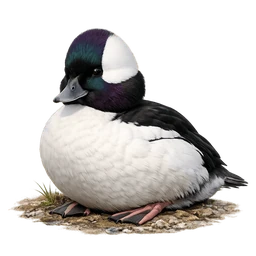
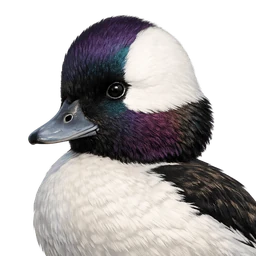
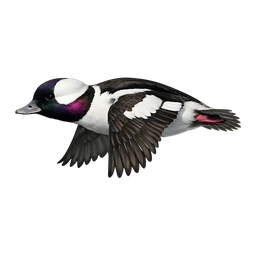
Unggas air (Waterfowl)
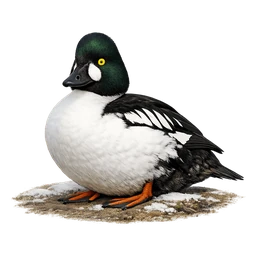
Bufflehead
Bucephala albeola
- tidak umum
- 40 km/h
- Risiko rendah
Smallest North American diving duck, with an oversized iridescent head. Nests in old woodpecker holes.
- Populasi
- ~1.3 million mature individuals; population trend increasing (>1.5%/year 1966–2015; ~88% increase over the past three generations)
- Habitat
- Breeds on small wooded lakes and ponds in boreal forest and aspen parkland across Canada/Alaska (with some western U.S. populations), nesting almost exclusively in old Northern Flicker (occasionally Pileated Woodpecker) tree cavities in poplar/aspen (pine in California); winters in sheltered coastal bays, estuaries, harbors and beaches as well as inland lakes, ponds and slow rivers.
- Fakta menarik
- The Bufflehead is North America's smallest diving/sea duck and depends almost entirely on tree cavities excavated by Northern Flickers for nesting, tying its breeding range closely to that woodpecker's distribution; the oldest known banded individual was at least 18 years and 8 months old (banded/recaught in New York, first ringed 1993).
- Sebaran
- Breeds across Alaska and Canada (with some western U.S. breeding); winters throughout the contiguous United States (both coasts, Great Lakes, interior waterways) and into coastal Mexico; a full migrant with a very large range (breeding extent ~11 million km², non-breeding ~17.3 million km²); rare vagrant to western Europe and occasional vagrant to Caribbean islands.
- Makanan
- Diving duck feeding mainly on aquatic invertebrates: insect larvae (e.g., dragonfly/damselfly nymphs, midges, snails) in freshwater; crustaceans and mollusks (shrimp, crabs, amphipods, isopods, mussels, snails) plus fish eggs (herring eggs) and small fish (sculpins, ratfish) in saltwater; aquatic plant seeds eaten occasionally/locally. Typical dives last ~12 seconds (rarely over 25) to depths of roughly 1.2–4.5 m.
- Ukuran
- 0,355 m
- Bentang sayap
- 0,55 m
- Masa hidup
- 8 tahun