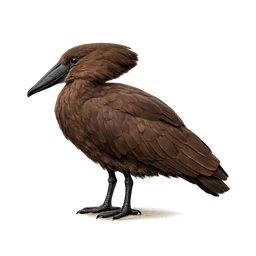
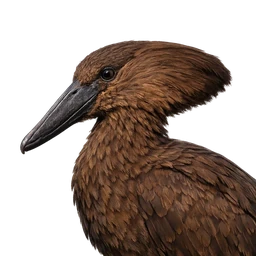
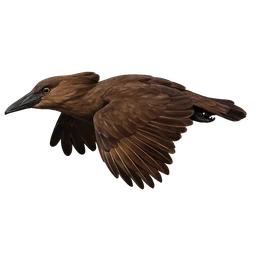
Jenjang dan burung perancah (Cranes & Waders)
Hamerkop
Scopus umbretta
- tidak umum
- 35 km/h
- Risiko rendah
Builds nests big enough for a human to sit in. Over 8,000 sticks, decorated with bones and bright objects.
- Populasi
- Not numerically quantified; the population size is "very large" with a stable trend; some describe local increases tied to artificial wetlands (rice paddies, fish ponds, reservoirs)
- Habitat
- Shallow wetlands and their margins: rivers, streams, seasonal pools, estuaries, reservoirs, marshes, mangroves, lake shores, and man-made habitats such as rice paddies and fish ponds; also forages in adjacent savanna and forest edge, generally within roughly 300-3,000 m elevation and near large trees used for nesting
- Fakta menarik
- A single hamerkop pair builds several enormous, roofed stick nests each year (three to five, using an estimated 8,000 sticks and 10-14 weeks of work, often over 1.5 m across and strong enough to bear a person's weight) whether or not they are breeding, and the abandoned nests are frequently taken over by owls, geese, and other birds.
- Sebaran
- Sub-Saharan Africa, Madagascar, and coastal southwestern Arabia (Yemen/Saudi Arabia); two subspecies recognized (S. u. umbretta across most of tropical Africa and Madagascar, S. u. minor along the West African coastal belt from Sierra Leone to Nigeria)
- Makanan
- Generalist carnivore of wetland prey: mainly fish and amphibians (especially frogs and tadpoles), plus shrimp, aquatic insects, grasshoppers and other invertebrates, and occasionally small rodents; forages by wading in shallow water and probing mud, sometimes stirring the substrate with its feet to flush prey
- Ukuran
- 0,56 m
- Bentang sayap
- 0,92 m
- Masa hidup
- 4,5 tahun