Jenjang dan burung perancah (Cranes & Waders)
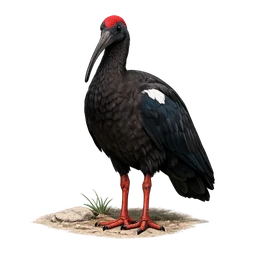
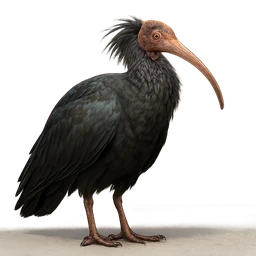
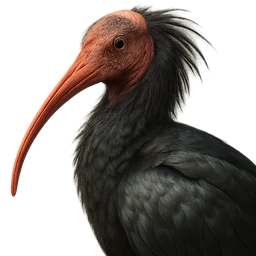
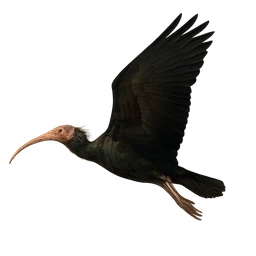
Northern Bald Ibis
Geronticus eremita
- mistis
- 64 km/h
- Terancam punah
Ancient Egyptians revered it. Nearly vanished, now clinging on in Morocco. Sacred mail.
- Populasi
- 200-249 mature individuals (trend listed "stable [suspected]"); field counts of the whole Moroccan wild population (the vast majority of the species) reached ~580 by end of 2015 and ~700 birds by 2019, up from a mid-1990s low of 59 breeding pairs. A separate critically depleted eastern remnant persists (~100 managed birds at Birecik, Turkey; Syria functionally extinct, one bird seen since 2015).
- Habitat
- Breeds colonially on remote rocky cliffs, escarpments, and coastal ledges in arid regions, often near rivers or the sea; forages in nearby semi-arid steppe, short/dry grassland, stubble and fallow fields, avoiding tall vegetation over ~25 cm; can occur up to ~3,500 m on migration routes used by reintroduced European populations.
- Fakta menarik
- In Birecik, Turkey, local tradition held that the Northern Bald Ibis migrated each year to guide Hajj pilgrims toward Mecca, and an annual festival celebrated the bird's springtime return — reverence that helped protect the eastern colony long after the species vanished from Europe and much of its former range.
- Sebaran
- Historically widespread across North Africa, the Middle East, and parts of southern/central Europe (extirpated from Europe 300+ years ago). Now two disjunct wild remnants: the dominant western population on Morocco's Atlantic coast (Souss-Massa National Park and Tamri, plus two sites confirmed in 2017), and a critically depleted eastern population (a small managed/semi-wild colony at Birecik, Turkey; Syria's wild population is functionally extinct — a single bird last seen in 2015). Human-led reintroduction (Waldrappteam project, including a migration-training program) has established breeding colonies in Austria, Germany, Spain, and Italy.
- Makanan
- Carnivorous ground forager taking lizards and tenebrionid beetles as staples, plus small mammals, ground-nesting birds' eggs/chicks, snails, scorpions, spiders, caterpillars, and other invertebrates probed from soil and sparse vegetation with its long curved bill.
- Ukuran
- 0,75 m
- Bentang sayap
- 1,3 m
- Masa hidup
- 12 tahun