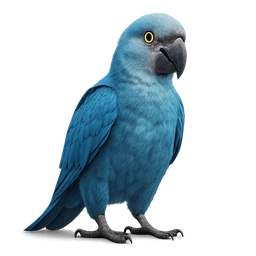
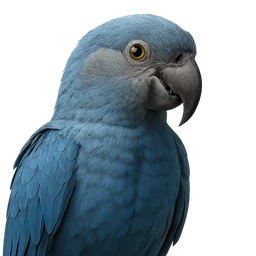
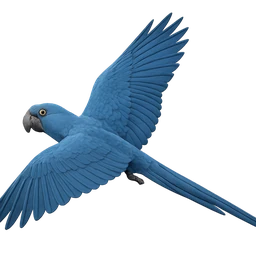
Burung paruh bengkok (Parrots)
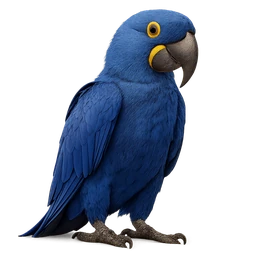
Spix’s Macaw
Cyanopsitta spixii
- legendaris
- 56 km/h
- Punah di alam liar
Declared extinct in the wild in 2000, reintroduced in 2022. The rarest macaw on Earth, and your message is priceless.
- Populasi
- Officially 0 mature individuals in the wild. Captive-bred birds were relocated from Germany to Brazil in 2020 purely to prepare for release; actual wild releases began June 2022 (8 birds) and December 2022 (12 birds, ~20 total that year, with 52 individuals reintroduced cumulatively since). First wild-hatched chicks were confirmed October 2023. As of November 2025, 11 individuals were confirmed still surviving in the wild — and all 11 were reported infected with a fatal circovirus (beak-and-feather disease) that same month, an acute new threat to the reintroduced cohort. Captive population is approximately 177 individuals (2022 figure; up from ~110 in 2015 and ~158 in 2018) — commonly rounded to "~150-200".
- Habitat
- Riparian gallery woodland dominated by Caraibeira (Tabebuia aurea/caraiba) trees along seasonal watercourses within the semi-arid Caatinga thorn-scrub of the Rio São Francisco drainage basin; classified broadly as subtropical/tropical dry forest and shrubland.
- Fakta menarik
- Spix's Macaw was declared Extinct in the Wild after the last known wild individual disappeared around 2000, and that official global status still stands today — even though a captive-breeding and reintroduction program has since released 20 birds into Brazil's Caatinga (June and December 2022), produced the species' first wild-hatched chicks in October 2023, and as of November 2025 has 11 free-flying survivors, all of whom were just diagnosed with a fatal circovirus outbreak.
- Sebaran
- Historically endemic to a small area of northern Bahia (near the Rio São Francisco), northeastern Brazil; functionally extinct in the wild since the last confirmed wild sighting in 2000. Reintroduction is active at its former range near Curaçá, Bahia: birds were relocated from Germany to Brazil in 2020 solely as preparation, with the first physical wild releases occurring June 2022 (8 birds) and December 2022 (12 birds).
- Makanan
- Seeds and nuts of Caraibeira (Tabebuia aurea/caraiba), Pinhão (Jatropha spp.), Favela (Cnidoscolus spp.), Joazeiro (Ziziphus joazeiro), and other Euphorbiaceae and native Caatinga plants.
- Ukuran
- 0,56 m
- Masa hidup
- 20 tahun