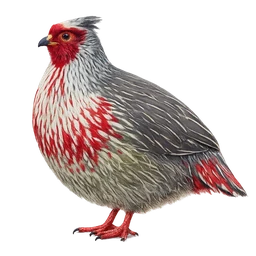
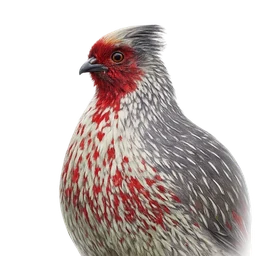
Profile
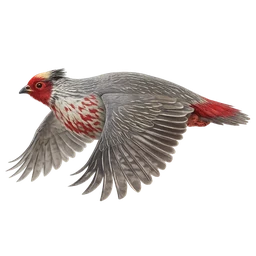
In flight
Game Birds
Blood Pheasant
Ithaginis cruentus
- uncommon
- 38 km/h
- Least Concern
The only pheasant in its genus, red-splashed and treeline-hardy. Forages in Himalayan snow without complaint.
- Population
- Global population size unquantified by IUCN; species reported as common and widespread in some areas, scarce in others, with an overall decreasing population trend due to habitat loss/degradation (timber extraction, overgrazing, agricultural conversion) and hunting pressure. Confirmed directly against the current IUCN global assessment (last assessed 12 June 2024, category LC retained despite the declining trend, since range size and decline rate don't meet higher-threat thresholds).
- Habitat
- Coniferous and mixed forests with rhododendron/bamboo scrub near the snowline in mountainous terrain, roughly 2,460-4,500 m elevation; migrates seasonally to higher elevations in summer and lower elevations in winter to avoid deep snow
- Fun fact
- Unlike most pheasants, which are polygamous, the Blood Pheasant is monogamous, with males courting females by flying breast-to-breast and performing high leaps; it is also the state bird of Sikkim, India.
- Range
- Himalayas and adjacent uplands: Nepal, Sikkim, Bhutan, northeastern India, Tibet, Myanmar, and central/south-central China (including Gansu, Qinghai, Sichuan, Yunnan, Shaanxi); IUCN lists range countries as Bhutan, China, India, Myanmar, and Nepal, extent of occurrence ~2,070,000 km^2
- Diet
- Primarily herbivorous - moss, ferns, pine shoots, buds, berries, and lichens, foraged along the snow line
- Size
- 0.43 m