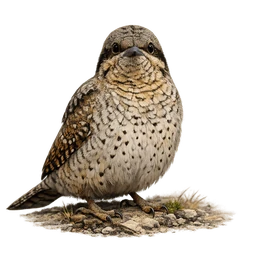
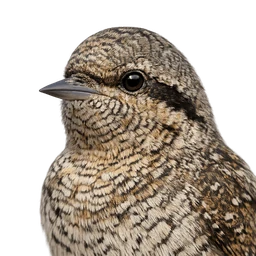
Profile
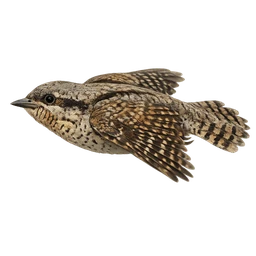
In flight
Woodpeckers
Eurasian Wryneck
Jynx torquilla
- epic
- 72 km/h
- Least Concern
A woodpecker that doesn't drill. Twists its neck like a snake when threatened — hence the name and the unease.
- Population
- Roughly 3.98-7.6 million mature individuals globally (BirdLife/IUCN 2021 estimate), stable population trend.
- Habitat
- Open forest, clearings, woodland with low undergrowth, wooded pasture, orchards, gardens, hedgerows and unimproved meadowland with scattered trees; favors drier, sunlit, open habitats and avoids damp ground and high mountains, occurring from sea level to about 3,300 m.
- Fun fact
- Despite belonging to the woodpecker family (Picidae), the Eurasian Wryneck cannot excavate wood and instead nests in existing cavities; when threatened at the nest it twists and writhes its head and neck like a snake while hissing, a defensive display that gives the genus Jynx (and the English word "jinx") its name — the English name "wryneck" itself is first recorded in 1585 and historically the bird was tied to a spinning string as a love charm to summon back an errant lover.
- Range
- Breeds across temperate Europe and western/central Asia; almost entirely migratory, with European/western-Asian populations wintering in sub-Saharan Africa and eastern populations wintering in the Indian subcontinent and southeast Asia; a resident subspecies (J. t. mauretanica) occurs in northwest Africa. Breeding/resident range EOO ~38.4 million km²; non-breeding range EOO ~56.2 million km² (BirdLife DataZone).
- Diet
- Feeds almost exclusively on ants (adults, larvae, and pupae), supplemented by other invertebrates such as beetles, moths, spiders and woodlice; forages mainly on the ground, capturing prey with its long, sticky, rapidly-flicking tongue.
- Size
- 0.17 m
- Wingspan
- 0.26 m
- Lifespan
- 10 years