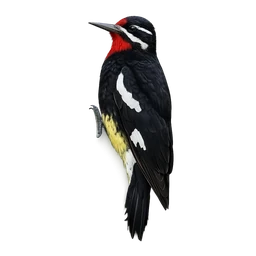
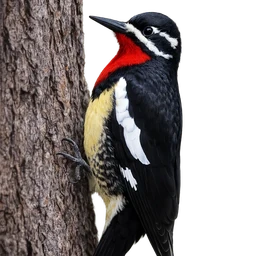
Profile
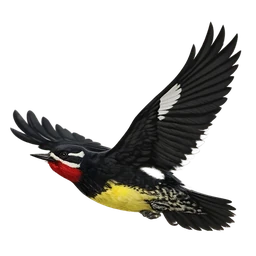
In flight
Woodpeckers
Williamson’s Sapsucker
Sphyrapicus thyroideus
- epic
- 42 km/h
- Least Concern
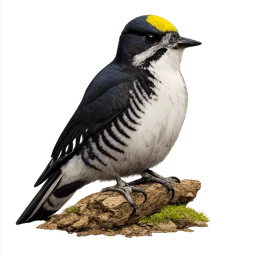
The male and female look so different that scientists classified them as two separate species for over 20 years.
- Population
- ~210,000–400,000 mature individuals globally (BirdLife/Partners in Flight estimate, ~2020); population trend decreasing
- Habitat
- Coniferous and mixed conifer-deciduous montane forests of western North America (Rockies westward), favoring drier, relatively open woodlands of ponderosa pine, Douglas-fir, lodgepole pine, grand fir, subalpine fir, and western larch; typically absent from moist western redcedar/hemlock forests; elevation range roughly 45–3,580 m per BirdLife
- Fun fact
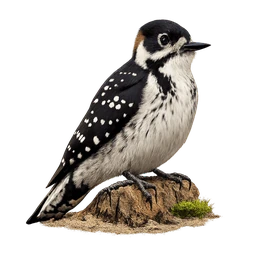
- Male and female Williamson's Sapsuckers look so different — the male glossy black with white wing patches and a yellow belly, the female barred brown-and-black with no white wing patch — that 19th-century ornithologists described them as two separate species: the female named Picus thyroideus in 1852, the male named Picus williamsonii in 1857 (with the female's plumage separately dubbed the "black-breasted woodpecker" by Cassin), until Henry Henshaw linked both sexes to the same nest in 1873.
- Range
- Western North America from British Columbia south through the Rocky Mountain and Pacific states to northern Mexico; partially migratory — northern/high-elevation breeders winter south to central Mexico while some populations are year-round residents; breeding range overlaps extensively with Red-naped and Red-breasted Sapsuckers
- Diet
- Primarily tree sap and phloem drilled from shallow "sapwells" in conifers year-round; shifts heavily to insects (carpenter ants, bark beetles, aphids, flies) during the breeding season to feed nestlings; adds fruit and seeds (e.g., madrone, juniper, pinyon pine berries) in winter
- Size
- 0.23 m
- Wingspan
- 0.43 m
- Lifespan
- 7 years