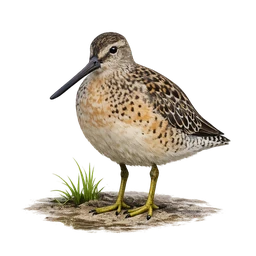
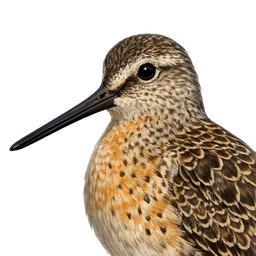
Profile
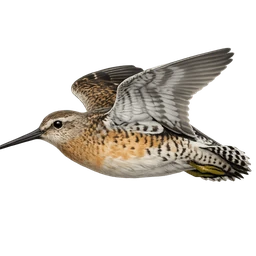
In flight
Cranes & Waders
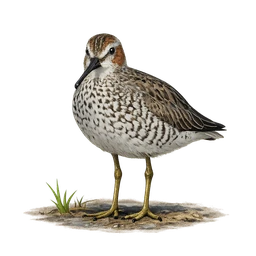
Short-billed Dowitcher
Limnodromus griseus
- common
- 28 km/h
- Starter
- Vulnerable
Probes the mud like a sewing machine. The bill is only short relative to the other dowitcher.
- Population
- 150,000–320,000 mature individuals (est. ~245,000), decreasing
- Habitat
- Breeds in subarctic taiga-shield ecotone (muskeg bogs, wet meadows, stunted spruce/tamarack/birch near treeline); on migration and in winter uses coastal estuaries, tidal mudflats, mangrove swamps, and salt ponds, favoring saltwater/brackish habitat over sandy beaches, with opportunistic use of flooded fields and sewage ponds
- Fun fact
- Short-billed and Long-billed Dowitchers were classified as a single species until 1950, and their bill lengths overlap so much that this measurement alone cannot reliably tell the two apart in the field — their calls are the most reliable distinguishing feature.
- Range
- Breeds across northern North America from coastal Alaska and Yukon through central Canada to Quebec and Labrador; migrates along coastal routes to winter from southern California/Virginia southward through Mexico, Central America, and the Caribbean, with Pacific-coast breeders reaching as far as Peru and eastern-breeding birds reaching as far south as Brazil
- Diet
- Buried invertebrates probed from mud — marine worms, small clams and other mollusks, crustaceans (fiddler crabs, shrimp), isopods and amphipods; also insects and larvae (beetles, flies, mosquitoes, midges) plus spiders and snails on the breeding grounds
- Size
- 0.28 m
- Wingspan
- 0.51 m