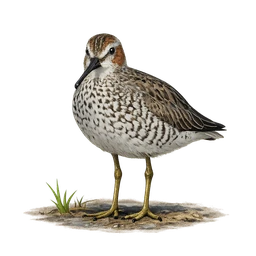
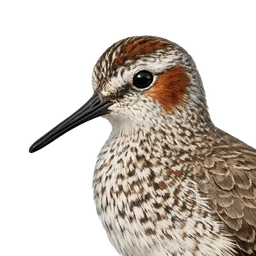
Profile
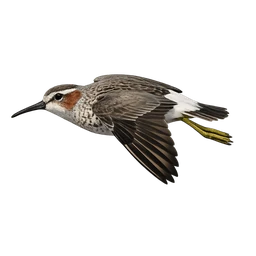
In flight
Cranes & Waders
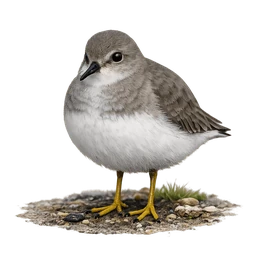
Stilt Sandpiper
Calidris himantopus
- common
- 28 km/h
- Starter
- Near Threatened
Long-legged sandpiper that wades belly-deep and sews the mud with its bill. Half shorebird, half yellowlegs cosplay.
- Population
- ~1.2 million mature individuals, declining (BirdLife/IUCN, 2023 estimate; 20-29% decline over three generations based on migration count data)
- Habitat
- Breeds on wet low-arctic/subarctic tundra (moist meadows and drier slopes with dwarf birch/willow/stunted spruce, and drier tundra farther north); outside the breeding season favors freshwater wetlands — marshes, ponds, flooded fields, and rainwater pools, plus saltworks/rice fields/brackish swamps in parts of South America — generally avoiding sandy ocean beaches and saltwater mudflats.
- Fun fact
- Stilt Sandpipers often feed at night, probing mud by touch rather than sight, and forage peaceably in mixed flocks with yellowlegs and dowitchers with little of the aggression seen in many other shorebirds.
- Range
- Breeds across northern Alaska and northern Canada; migrates through the central United States (roughly Texas/Louisiana to North Dakota/Saskatchewan) and the eastern seaboard; winters mainly in interior South America (Peru, Bolivia, Paraguay, Brazil, Uruguay, Argentina), with smaller numbers in Mexico, the Caribbean, Florida, Texas, and California; vagrant to western Europe, Japan, and Australia.
- Diet
- Aquatic invertebrates such as beetles, snails, insect larvae (midges, mosquitoes, water bugs), and small frogs, plus seeds and leaves/roots of aquatic plants; forages tactilely, probing mud with its bill while wading (often described as dowitcher-like, also jabbing by sight), and frequently feeds at night.
- Size
- 0.205 m
- Wingspan
- 0.395 m
- Lifespan
- 10 years