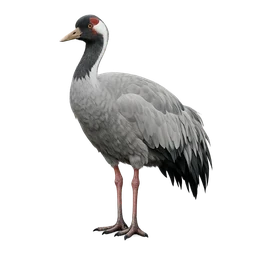
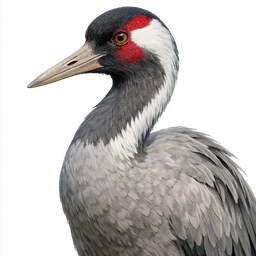
Profile
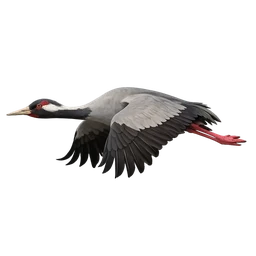
In flight
Cranes & Waders
White-naped Crane
Antigone vipio
- rare
- 50 km/h
- Vulnerable
Fewer than 8,000 left. Mates for life and dances to keep the bond. That long white nape stripe is unmistakable.
- Population
- Roughly 6,250-6,750 birds total (~3,700-4,500 mature individuals per the 2018 IUCN/BirdLife assessment), decreasing; other sources give higher figures (Smithsonian ~4,900-5,300; International Crane Foundation >11,000), likely reflecting different count years/methods
- Habitat
- Breeds in grassy marshes, wet sedge meadows, and reedbeds in broad river valleys and lake depressions within steppe and forest-steppe zones; winters on freshwater lakes, farmland, and occasionally coastal flats.
- Fun fact
- White-naped Cranes forage by digging deep for buried tubers and roots, a strategy that lets them share wintering wetlands with Red-crowned Cranes, which instead pick food from the surface.
- Range
- Breeds in northeastern Mongolia, northeastern China, and adjacent southeastern Russia (Dauria, Amur/Ussuri basins, Songnen/Sanjiang plains); winters mainly along the middle-lower Yangtze River (e.g. Poyang Lake) in China, the Korean DMZ, and southern Kyushu, Japan, with vagrants recorded in Taiwan and Kazakhstan.
- Diet
- Omnivorous. During the breeding season eats wetland plants, tubers, roots, and seeds (often dug from deep in the substrate); in winter and migration shifts to rice, waste grain, and cereal crops, supplemented with insects and small vertebrates such as amphibians and rodents.
- Size
- 1.2 m
- Wingspan
- 2.05 m
- Lifespan
- 20 years