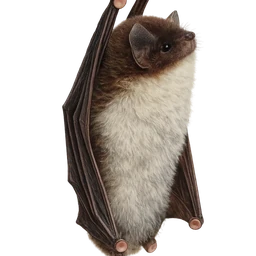
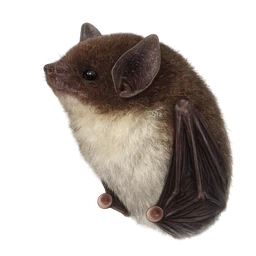
Profile
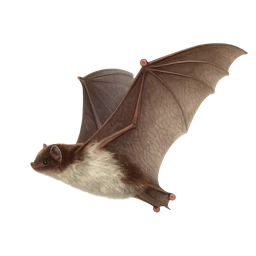
In flight
Bats
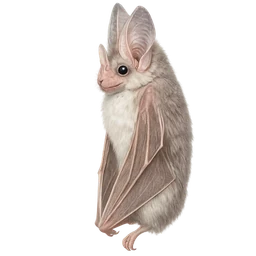
Spix’s Disc-winged Bat
Thyroptera tricolor
- uncommon
- 31 km/h
- Least Concern
Tiny suction discs on its thumbs and hind feet let it cling to the inside of rolled heliconia leaves. One leaf, one bat.
- Population
- No numerical global population estimate published; described as widespread and generally common within suitable Heliconia/Calathea-roost habitat, with a stable population trend per IUCN
- Habitat
- Lowland and submontane tropical/subtropical evergreen forest, second growth, and forest edge, sea level to ~1,800 m; roosts by day inside tightly furled young leaves of Heliconia, Calathea, and similar broadleaf plants, clinging head-up via adhesive thumb and foot pads, relocating roosts roughly every 1-2 days as leaves unfurl
- Fun fact
- Spix's disc-winged bat has circular, sucker-like adhesive disks on its thumbs and hind feet that let it cling head-up to the slick inner surface of a single furled Heliconia or Calathea leaf — a roost it must abandon and replace every day or two as the leaf unfurls and loses its grip-friendly curl.
- Range
- Southern Mexico through Central America (Guatemala, Belize, Honduras, Nicaragua, Costa Rica, Panama) into northern and central South America, including Colombia, Venezuela, the Guianas (Guyana, Suriname, French Guiana), Trinidad and Tobago, Ecuador, Peru, Bolivia, and Brazil
- Diet
- Insectivorous; gleans small arthropods from leaf/vegetation surfaces rather than hawking prey in flight; diet dominated by jumping spiders (~93% of fecal samples in one study), leafhoppers (~81%), moths/butterflies (~63%), and true flies (~59%); individuals eat up to roughly 0.8 g of insects per night
- Size
- 0.073 m
- Lifespan
- 3 years