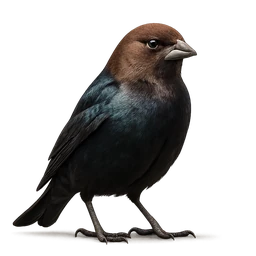
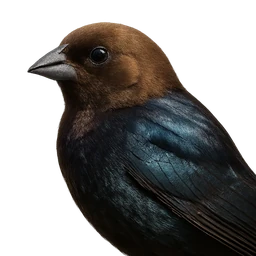
Profile
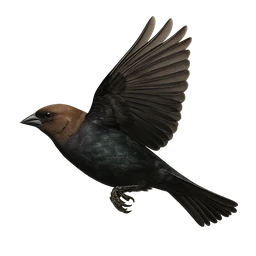
In flight
Songbirds
Brown-headed Cowbird
Molothrus ater
- common
- 48 km/h
- Starter
- Least Concern
Drops your message in someone else's mailbox and calls it a day. Work smarter, not harder.
- Population
- Very large but slightly declining; Cornell/Partners in Flight estimate the global breeding population at roughly 130 million, with North American Breeding Bird Survey data showing a slight decline from 1966-2019 (BirdLife DataZone also lists the population trend as \"decreasing\"); still among North America's most abundant songbirds and not close to any threatened threshold
- Habitat
- Open and semi-open country — grasslands with scattered trees, pastures, agricultural fields, woodland edges, brushy thickets, orchards, and residential/suburban areas with feeders; generally avoids unbroken forest; historically followed bison herds on the Great Plains, spread eastward after 1800s deforestation, now commonly follows livestock
- Fun fact
- The Brown-headed Cowbird is an obligate brood parasite that never builds its own nest — females can lay up to 40 eggs in a season into the nests of other songbirds (over 220 documented host species), and some females engage in \"mafia behavior,\" destroying a host's eggs if their own parasitic egg is removed, which forces the host to rebuild and accept a cowbird egg in the new nest roughly 85% of the time.
- Range
- Native to temperate and subtropical North America, common across almost all of the continental US and southern Canada, extending into central Mexico; northern/interior populations migratory, wintering in the southern US and Mexico, while southern populations are largely resident
- Diet
- Primarily grass and weed seeds plus crop grains, with insects (grasshoppers, beetles, and other invertebrates flushed by grazing animals) making up roughly a quarter of the diet; females also eat snail shells and eggs for calcium; forages on the ground, often alongside cattle and other livestock
- Size
- 0.19 m
- Wingspan
- 0.36 m
- Lifespan
- 16 years