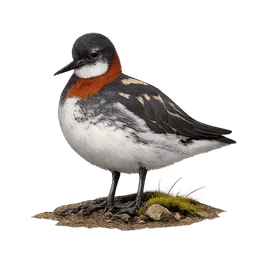
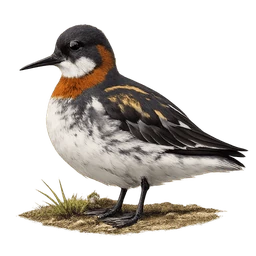
Profile
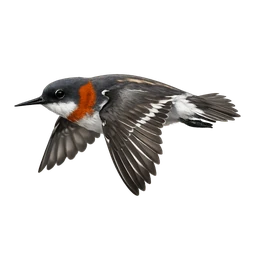
In flight
Cranes & Waders
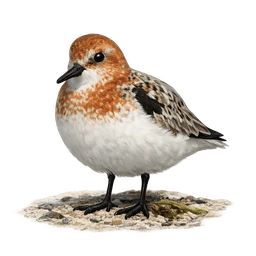
Red-necked Phalarope
Phalaropus lobatus
- uncommon
- 40 km/h
- Least Concern
Spins in tight circles on the water to vortex up plankton. Tiny, weird, and effective.
- Population
- c. 3.6–4.5 million mature individuals globally, decreasing trend (Wetlands International 2015, via BirdLife DataZone)
- Habitat
- Breeds on Arctic, forest-tundra, and alpine tundra near freshwater pools, ponds, lagoons, and streams with marshy, sedge- or moss-fringed margins (also sparsely vegetated lava fields in Iceland); on migration uses inland saline/hypersaline lakes and coastal marshes; winters almost entirely pelagically at sea, foraging in oceanic upwelling zones and other plankton-rich marine areas.
- Fun fact
- Red-necked Phalaropes have reversed sex roles for a shorebird — the more brightly colored females compete for mates and leave incubation and chick-rearing entirely to the drabber males — and both sexes feed by spinning rapidly in tight circles on the water to draw plankton up to the surface.
- Range
- Circumpolar Arctic breeder across North America (Canada, Alaska) and Eurasia (Iceland, Scandinavia, Russia); a long-distance migrant that winters at sea off western South America (Peru/Ecuador upwelling), the Arabian Sea, and from Indonesia to western Melanesia, with passage through much of Europe, the Middle East, and Asia and frequent vagrancy far outside this range.
- Diet
- On the breeding grounds: adult and larval flies, beetles, caddisflies, ants and other small invertebrates (snails, crustaceans, worms), tadpoles, and some seeds. On migration and in winter: brine-fly larvae at saline lakes and, while feeding pelagically at sea, zooplankton such as copepods and euphausiids picked from the surface — often stirred up by the bird spinning rapidly in tight circles to create a small whirlpool.
- Size
- 0.185 m
- Wingspan
- 0.37 m
- Lifespan
- 5 years