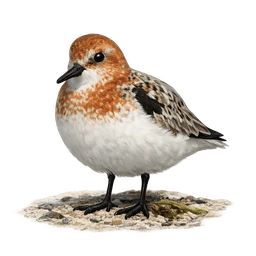
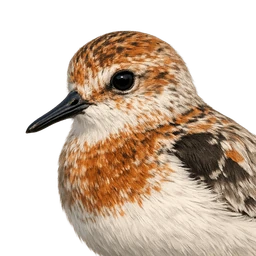
Profile
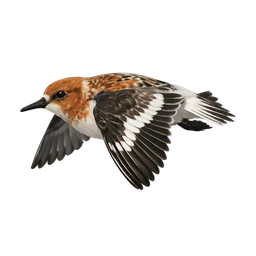
In flight
Cranes & Waders
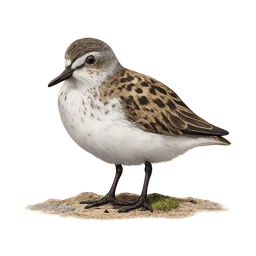
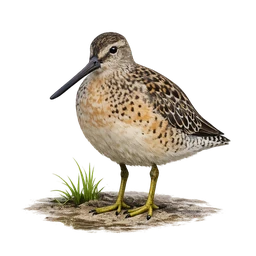
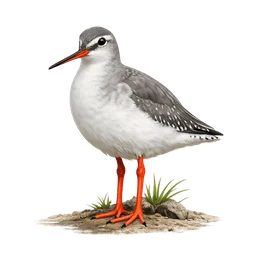
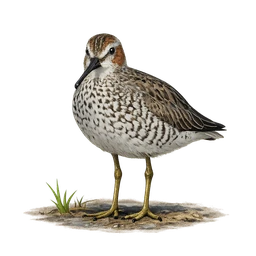
Sanderling
Calidris alba
- uncommon
- 40 km/h
- Least Concern
Chases the surf line back and forth on twinkling feet. The beach's tiniest commuter.
- Population
- 900,000–1,200,000 mature individuals, decreasing globally (with regional divergence: >40% declines in North America, increases in the East Atlantic Flyway since 1979, relative stability in SW Asia/Southern Africa wintering populations)
- Habitat
- Breeds on barren, stony high-Arctic tundra near freshwater lakes/ponds, with sparse vegetation (willow, saxifrage) used for nest lining; outside the breeding season found on sandy beaches, hard-packed tidal mudflats, estuaries, and rocky shores, plus occasional inland lake shores on migration.
- Fun fact
- Unlike most sandpipers, the Sanderling lacks a hind toe — part of what lets it sprint back and forth along the swash of breaking waves, giving it its famous "wind-up toy" foraging gait as it snatches prey uncovered by receding water.
- Range
- Breeds circumpolar in the high Arctic (Arctic Canada — the bulk of the population, ~700,000 breeding adults — plus northernmost Alaska, Greenland, Norway, and Siberian Russia); winters on coastlines nearly worldwide, from temperate North and South America through Europe, Africa, southwest Asia, and Australia, making it one of the most widely distributed shorebirds on Earth (breeding EOO ~13.6M km²; non-breeding EOO ~366M km²).
- Diet
- Small invertebrates — isopods, amphipods, mole/sand crabs, polychaete worms, mollusks (bivalves), and insects (crane flies, midges, mosquitoes, beetles) — plus large numbers of horseshoe crab eggs at spring stopover sites like Delaware Bay; some plant material (seeds, algae, buds, roots, shoots) taken when animal prey is scarce, including on the Arctic breeding grounds.
- Size
- 0.19 m
- Wingspan
- 0.38 m
- Lifespan
- 13 years